Tutorial – How to identify fake trilobites.
by Dipl. Geol. Jens Koppka, Heiko Sonntag & Horst Burkard
2004
As trilobite collectors and preparators visiting many fossil
shows and fairs we have had the chance to obtain some experience
with fake trilobites. The knowledge we have gained over so
many years allows us to quickly identify false material while
it may be very difficult for others who are not so familiar
with how fake trilobites are made. Unfortunately the trilobite
market seems to be flooded with false stuff at the moment,
the “quality” of which getting better continuously,
making it even harder to tell. We therefore thought it a good
idea to make our knowledge available to others in a way easily
understood.
We also have to point out that there is no regime of control
at the moment, as far as trilobite sales offers on the internet
or on fairs are concerned, and no action taken against dealers
who knowingly sell false material (like exclusion from shows
and/or legal action). This unwelcomed situation almost encourages
certain dealers to take advantage and the honest dealers are
the ones who have to pay for it. Horst Burkard undertook to
investigate many of the false trilobites coming from Morocco,
using one of the most brutal methods available …. he
took a saw! The results of his little massacre were on display
during the Hamburg Fossil Show in 2003 and we had a chance
to talk to him and take photos. The following text is by Jens
Koppka, photos taken by Heiko Sonntag.
Historical Aspects
Faking trilobites is not any new business. Repairing, restoring,
adding to or plain faking of fossils is almost as old as the
fossil trade itself, the problem being, as with most areas
of collecting, that money can be made and sometimes has to
be made due to lack of other options and wide-spread poverty.
The famous 19th century trilobitologist BARRANDE employed what
he called “rock men” to search the areas near Prague
for trilobite specimens. Particularly interesting finds resulted
in good money and some of those “rock men” could
not help but fail their employer and produce false trilobites
in order to get more money for them. With the beginning of
the trilobite trade at the end of the 19th century many of
these faked specimens found their way even into the collections
of great museums around Europe where they are on display even
today as refreshing curiosities (Budik & Turek, 2003).
A favoured way to fake trilobites was simply to assemble new
specimens from parts, originating at times not only in different
specimens but even in different genera, and thereby making
the “trilobite” complete, resulting in higher prices
when sold. Some of these “rare species”, which
had been sold to museums and educational institutions, look
quite grotesque in our time. There was, for example, a trilobite
assembled from the cephalon of a Phacops, the pygidium being
an Odontochile and the thorax consisting of merely 4 segments.
(SNAJDR, 1992). However, at those times, the faked trilobites
at least consisted of real parts. They were created in a “make-one-out-of-two”-manner
but the parts were real. Fakes of this nature are created unto
this very day, but the availability of resins made it possible
to fake entire trilobites by simply casting them.
Following sensational finds of large and bizarre trilobites
in the Moroccan desert near Alnif, Erfoud and Tabourikt over
the last three decades a whole trilobite industry evolved.
This happened in an area where education was scarce and the
availability of electricity and running water restricted. Native
Moroccans and nomads found a welcomed, if not their only income
in searching for and preparing trilobites. Over the years,
trilobites have become an important economical factor in the
generally rather poor areas of the High Atlas mountain range.
According to BURKHARD & BODE (2003), there are well-known
manufacturers in Morocco who produce fake trilobites or rather
trilobite models. Fossil dealers who go to Morocco to buy trilobites
are well aware of that and know that these trilobites are not
real. Neither are these models sold to them as real trilobites
but reproductions. The cheating does not start there, it starts
when these reproductions are thrown onto the trilobite market
in masses and sold as the real stuff for little money. Faking
of this nature started in the 80s due to increasing demand
for giant Paradoxides and lack of the real thing. In the beginning
the old “make-one-out-of-many” was common, but
very soon whole trilobites were faked. It is verified that
it was not the Moroccans who started to fake trilobites but
American as well as European dealers who inspired them to do
so. The dealers then sold the fake trilobites as the real thing.
Meanwhile the faking has reached levels that include almost
any known Moroccan trilobite species and it is possible that
there is more false material floating around at this time than
real.
But the repairing, restoring or faking is not restricted to
Morocco. It applies as well to some of the Russian trilobites
coming from the St. Petersburg region, although the amount
of faking is not comparable to that in Morocco. The reconstructions
are usually restricted to replacing missing parts of the exoskeleton,
fixing broken-off eyes and spines (every once in a while a
whole pygidium may be replaced), waxing and colouring of the
cuticle or the mounting of isolated trilobites onto matrix
other than the one it was found in. I experienced this myself
when trying to prepare the hypostome of a Dysplanus from the
Lower Ordovician. The trilobite was completely real but mounted
artificially onto a piece of matrix from the Asery level. Most
likely it was done because a trilobite on a nice piece of matrix
sells for a much higher price than an isolated specimen. From
a scientist’s point of view it looked as if this species
from the Kunda level had still existed in the younger Asery
level, which is not the case.
It has to be said, though, that the Russian preparators rarely
play dirty. The trilobites are real but in most cases (Asaphus,
Illaenus) are very quickly extruded from the matrix with high-powered
blasters using very aggressive media so that the exoskeleton
gets an unnatural shine. They look very nice when finished,
but have most likely been polished and waxed and thereby lost
surface detail. Looking at more carefully prepared specimens
you will find the characteristic surface details, little inconsistencies
produced by nature but lost in specimens that have been blasted
too aggressively. The more rare spiny trilobites like Hoplolichas,
Boedaspis, Paraceraurus and so on are for the most part very
carefully and skilfully prepared and therefore very expensive.
Fake trilobites are known even from Bolivia. I have not had
a chance yet to take a look at such material myself but we
have been assured that there are assembled trilobites on the
market as well as complete fakes made of plaster or resin including
both positives and negatives. So watch out!
Some hints as to identifying fake Moroccan trilobites
1. air bubbles in matrix and exoskeleton as signs of resins.
If you discover tiny holes in the matrix or the
trilobite exoskeleton you can assume you are dealing with a
fake trilobite.
These tiny holes, usually less than 0,5 mm in diameter, are
the results of bursting bubbles of air that formed during the
hardening process of the resin used to cast the trilobite.
(see Picture1).
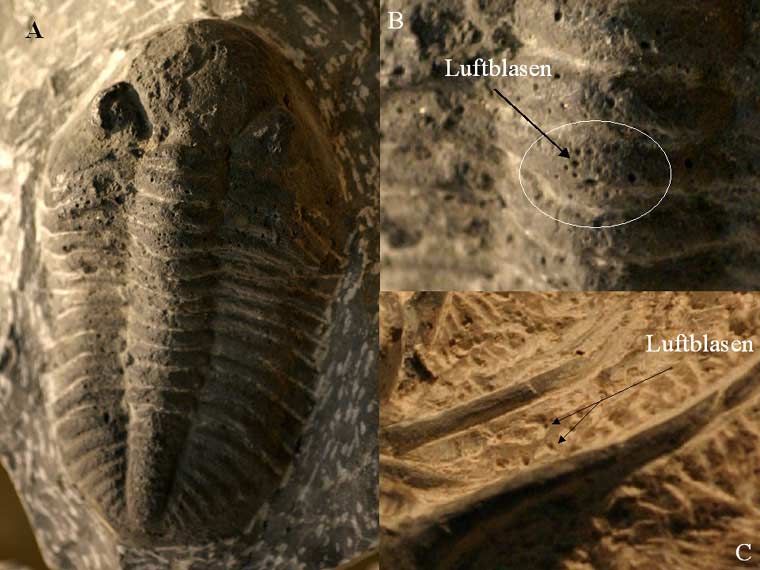
Picture 1: A) simple fake, a Phacops trilobite
completely made of resin, the cast trilobite then mounted onto
the matrix,
the tiny holes in the resin surface can be easily seen. B)
magnified view of part of the axis. C) air bubbles in the matrix
of a faked Dicranurus indicate that the trilobite including
underlying
false matrix has been mounted onto a piece of real rock, the
resin shows an unnatural brown colour, real matrix should be
of a dark grey.
2. differences in matrix colour frequently with cast trilobites
If you find different colours in the matrix of Devonian trilobites,
for example a light brown close to the trilobite while the
rock, once you turn it over, is of a dark grey, this indicates
there may be trouble ahead. Usually the rock is of an evenly
dark grey (Hamar L’Aghdad), reddish or light yellow (Laatchana)
colour. So, if there are differences in colour as described
and in addition to that very extensive preparation marks on
the surface (to hide tiny holes), then both the trilobite and
an underlying layer most likely were cast and later mounted
on some real piece of rock.
In Cambrian giant trilobites you can sometimes find colour
variations of the matrix that may indicate that the specimen
was assembled from different individuals. Look for thin lines
were parts may have been glued together and their respective
colours. Trilobites without tampering should have an evenly
levelled and coloured matrix.
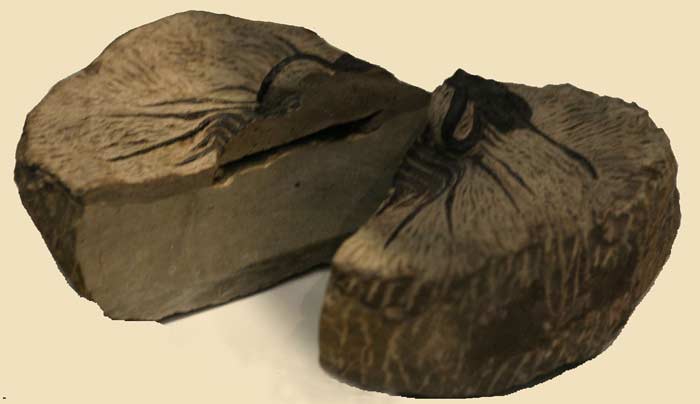
Picture
2: complete fake of a spiny Moroccan trilobite, Dicranurus
monstrosus. The trilobite plus an underlying
layer were cast
from brown resin and then mounted on top of real rock. The “trilobite” was
then painted, the surrounding areas covered with preparation
marks. The saw proved it! Notice the hole underneath the “trilobite” and
the colour difference between the brown resin layer on top
and the real rock beneath which is grey. Photo taken by Sonntag,
sawed up by Horst Burkhard.
3. crack line in Devonian trilobites as an indication of authenticity
If you cannot find any crack line in Devonian trilobites that
can be followed on throughout the surrounding matrix then be
suspicious. These crack lines are characteristic for authentic
trilobites from the very hard rocks of the Devonian of Morocco.
It is hard to find a trilobite without splitting it with your
hammer. The absence of a crack line may be an indication of
a fake trilobite so take a close look.
4. colour and substance of the trilobite exoskeleton
The exoskeleton of most Moroccan trilobites is
of black, in some rare cases of dark brown colour. Many faked
trilobites
show different colours, often brownish, with an unnatural shine
to it. Making careful use of your front teeth, you can test
the trilobite for authenticity. Fake trilobites will feel “soft”,
like plastics. This method is simple and safe at the same time,
because the nerves in your teeth are sensitive enough to tell
the difference without damaging the specimen. Authentic trilobites
are much harder than faked ones made of resin. Try it using
your toothbrush and some piece of rock. But please be careful,
a slight touch will do, don’t try and bite into it!
As far as trilobites from the Ordovician and Cambrian of Morocco
are concerned, their exoskeleton has been replaced with hydrated
iron oxides like lemonite, the colour being a shade of brown
rather than yellow or black, as has been seen in some faked
trilobites.
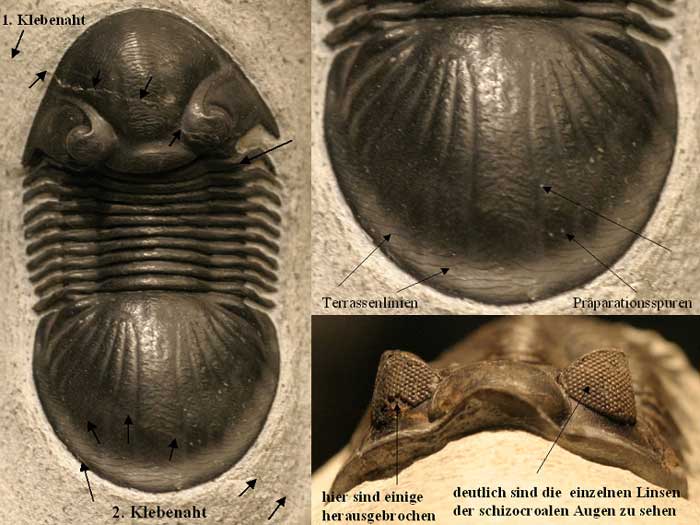
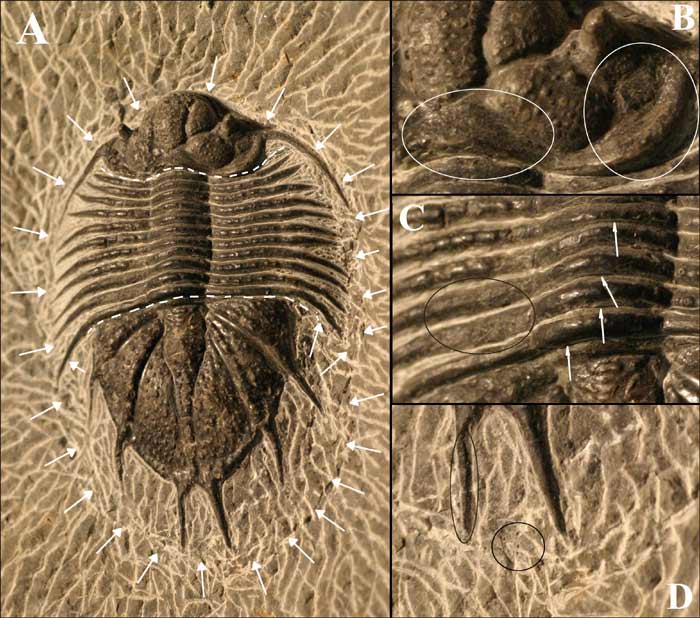
Picture 3: these trilobites are authentic specimens, for only
if you know what real trilobites look like will you be able
to identify the faked ones. The Paralejurus on the left shows
the characteristic crack lines of a Devonian trilobite (marked
by arrows), the upper one clearly visible on the cephalon,
the lower one not so obvious. Top right: clearly visible terrace
lines on the pygidium of the Paralejurus. These lines will
be missing in faked trilobites or specimens that have been
treated too aggressively with a blaster. Notice the tiny white
spots, they are preparation marks resulting from direct hits
with the tip of the prep needle. But, of course, they will
also be gone once a blaster has been used in the manner described.
Bottom right: the individual eye lenses of trilobites of the
order Phacopida are a sign of authenticity because they are
(still) hard to fake. It should be noticed, though, that schizochroal
eyes are peculiar to the Phacopina, which are abundant in the
Devonian of Morocco but of course there are other trilobites
as well (Lichida, Harpetida, Proetida).
5. morphological characteristics, surface details and trilobite
eyes
The exoskeletons of real trilobites very often
show fine structures, inconsistencies and ornamentations, there
are terrace lines
(see the Paralejurus above), little knots, knobs and
spines. Taking a close look at the trilobites’ eyes will
be helpful as, e.g., the Phacopina have schizochroal
eyes, the individual lenses clearly visible to the naked eye.
Faked trilobites
usually lack these characteristic details … it is
hard to copy nature perfectly. Faked Phacopina usually have
smooth eye surfaces, because the production method of cast
trilobites does not allow for such details to be reproduced.
6. UV-lights and solvents as tools to identify resin
If you are not sure whether you are dealing with a fake trilobite
a UV-light may be of assistance. Resin reflects ultraviolet
light and therefore starts gleaming when exposed to a UV source.
A real trilobite is mineralized, it has the same reflection
habits as the surrounding matrix. Be careful, however, when
testing waxed or finished trilobites like those coming from
Russia, they may start gleaming under UV light and still be “real”.
Waxing and finishing is a commonly used method to increase
contrast or conceal minor damages to the exoskeleton.
Moroccan trilobites sometimes are covered with an unidentifiable
black paste, both real specimens and faked ones. We use a solvent
like Aceton or Bindulin to remove such patinas from trilobites.
Take a paintbrush and confront your trilobite with the solvent
and within seconds the paste will come off, so do other artificial
colourings. Use the solvent on real trilobites to remove the
paste and see what remains ….. perhaps not too much,
if you are unlucky. If there are restored areas they will appear
white because the colour came of.
7. The ultimate and final solution – the saw!
If you are still in doubt about the authenticity
of your trilobite then saw it up with an appropriate saw (diamond-covered
blade).
There is a hypostome? Bad luck, chances are you just sawed
up a real trilobite! There is a hollow area underneath the
trilobite
and resin has
been used? Then your trilobite was fake. But it should not
be necessary to saw up your specimen unless you want to prove
its lack of value 100%.

Picture 4: a completely faked Burmeisterella, the hole underneath
the cast trilobite can be easily seen, the use of a shiny finish
to pretend a real trilobite exoskeleton is evident. This fake
was 25 cm in length. Photograph taken by Sonntag, specimen
owned and sawed up by Burkhard.
Examples of faked Moroccan trilobites
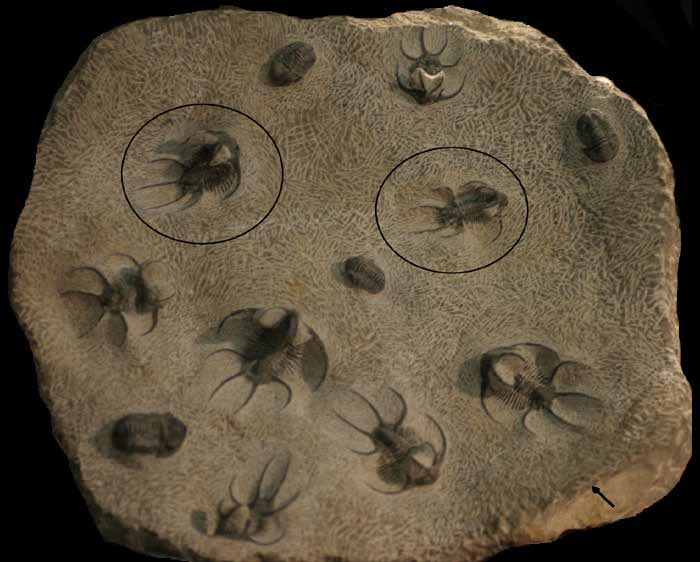
Unnatural trilobite assemblages
Frequently seen on shows are the combinations of various faked
trilobites on a single plate. I call this a “faked assemblage” (see
pic. 5). These plates tend to be circular in shape, thin and
slightly hollow. I have even seen clocks mounted to the center,
surrounded by cast trilobites. There are simply no such assemblages
in nature. This does not mean there cannot be several authentic
specimens on a single plate, it simply means there are no such
natural parties of different species that often do not even
appear in the same geological formation.
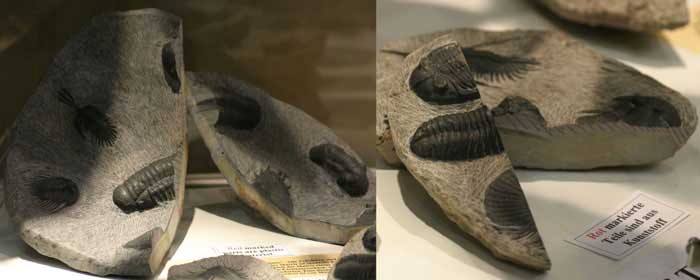
Picture 5: completely faked trilobite assemblages, all made
of resin with an underlying layer and mounted onto real rock,
casts identified as: Leonaspis, Walliserops, Crotalocephalus,
Paralejurus, and something unidentified on top (left image),Odontochile,
Psychopyge, Phacops and Scutellum (right image). Photography:
Sonntag, specimens owned and sawed up by Burkhard.
The "Homalonotida"-Fake or
Trilobites that do not exist
Some of the most impressive fakes coming from
Morocco are the complete "Burmeisterellas" (Picture
6). To the best of our knwoledge, unto this day no authentic
complete specimen of this genera has actually been found in
den Devonian
of
Morocco,
making
it more difficult to tell fakes from the real thing. It has
to be said that all complete specimens we saw so far turned
out to show manipulations, at least. Burmeisterella belongs
to the
Homalonotidae, close relatives to the Calymenia.
The partial remains of these large trilobites are found
isolated in the Devonian of Morocco. There do not seem to
be complete specimens. They make for very impressive trilobites
and it is no wonder that inventive Moroccans took all the
parts they could find - cephalons, pygidias, pleurae,
etc.- and assembled them to form what they believed would represent
a
complete
specimen of
this
genera. They just took every rock that was found to contain
parts of these Burmeisterellas, extracted the parts
completely from the surrounding
matrix
and collected them until they had everything they needed to
assemble a trilobite. According to Mr. Burkhard the Moroccans
exchange missing parts among each other: "I need pygidia
of this spiny trilobite and I have pleurae of that species
that you are looking for, let's
make a deal."
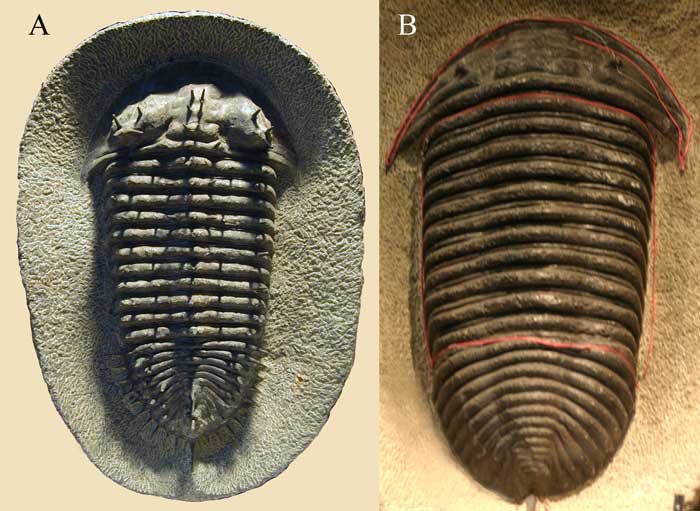
Picture 6: The "Homalonotida"-Fake.
A: Spiny Burmeisterella
sp.?
(Spines are actually tiny Orthocerata glued onto the exoskeleton, real
trilobite parts are assembled and fixed with resin onto a prepared piece of real
matrix.
B: Smooth Burmeisterella sp.? Cephalon and pygididum of this trilobite
consist of real trilobite parts, the throrax section marked by the red lines
is
made
of
resin. Both faked specimens are approximately 25 cms in length. Photos: Sonntag,
B: Photo from the collection of Burkhard. P.S. In 2002 Heiko and me saw these
"trilobites"
for the first time and were both fooled.
Once they have all the parts they need - real
parts but coming from various individuals - they will take
them and place them one by one onto a piece of prepared
matrix, most likely specially made from the Devonian
of Morocco, using resins and plaster. There seems to be a spiny
and a non-spiny type of Burmeisterella. The first
one, however, if it does exist in nature at all, was in our
case faked by glueing tiny Orthocerata (the tiny shells of
a kind of cephalopoda) onto the exoskeleton in order to mock
real spines. We have been assured by Mr. Burkhard that these
Orthocerata have been found in certain places
in such
masses that they are used frequently now to mock spines of
all sorts, making it much easier to produce fakes.
In former times the mock spines had to be made from plastics,
it is much more comfortable using the tiny Nautiloids. So once
the "trilobite" has been assembled the Orhocerata are glued onto the cephalon, thorax, pleurae and pygidium and
there you
go - a fantastic looking trilobite, wow! Well, in the end most
of the material used to produce the trilobite is authentic,
it is just that it does not come from the same individual.
There are, however, cases in which only the cephalon and
pygidium are real and the thorax made of resin as can bee seen
in Picture 6-B.
The quality of these fakes can be very good, at least the trilobites
look very impressive! Some of the less sophisticated fakes
- mostly of the smooth kind of Burmeisterella in
a brownish color - often show unnatural distances between the
pleurae
(see Picture 7-A), the matrix in between looking carved. The
first time we saw this it already looked sort of suspicious
to us but we could not be sure until we saw the sawed-up pieces
(see Picture 7-C) of Mr. Burkhard during the Hamburg Fair's
special exhibition on faked trilobites in December of 2003.)
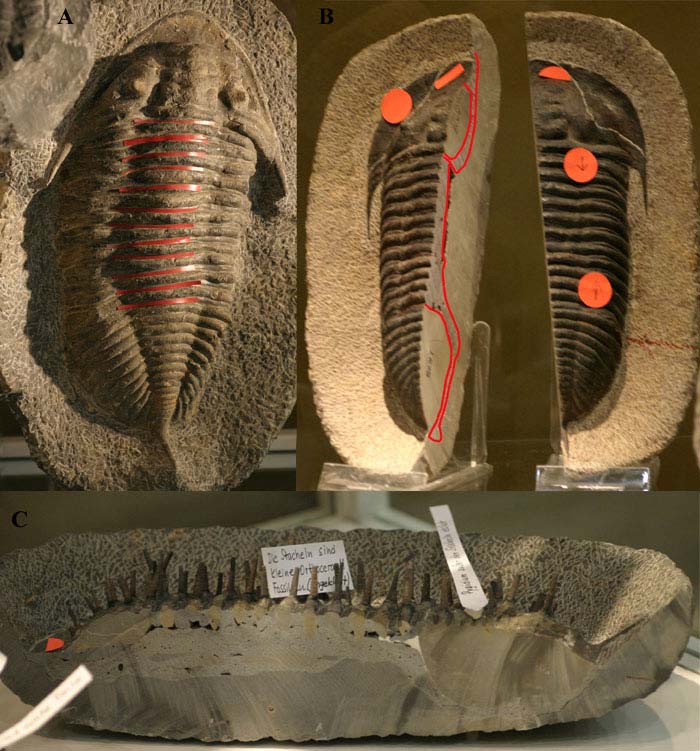
Picture 7: more examples of faked Homalonotida from
Morocco. A: the red stripes mark the resin in between the assembled
pleurae, the right side of the pygidium was most likley broken
off, so the right pleurae were shortened in order to pretend
that the trilobite was still partially buried inside the
matrix. B: cutting right through the "trilobite",
the red lines and spots marking areas made of resin, the
whole thorax,
the free cheeks and the anterior border are faked and made
of resin. C: a sawed up spiny Homalonotid, the spines are
actually tiny Othocerata, real trilobite parts appear yellowish
while the resin looks grey. Debris of rock has been mixed with
the plaster used to save material. All photographs taken by
Sonntag, trilobites belonging to and sawed up by Burkhard.
Fakes of giant Cambrian trilobites
The giant Paradoxidae from the Cambrian
of Morocco are well-known and sought-after trilobites worldwide.
It does
not
surprise
that these trilobites have become the subject of extensive
faking activities. The demand is satisfied by producing false
material either assembled from isolated trilobite parts or
completely
made of resin or plaster. These fakes now seem to represent
the major part of the Paradoxidae traded and it is
not that easy
to acquire
the real thing. At the same time it has become more and
more difficult to identify
fakes (see Picture 8-A),
although
there
are
still
some
very
bad ones
around that can be easily told (see Picture 8-C), faking is
an art itself!
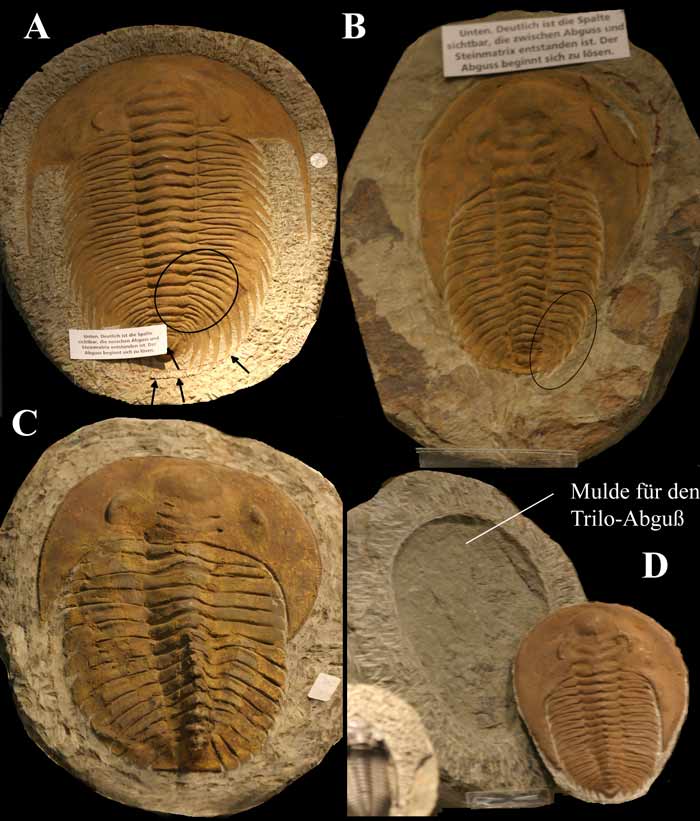
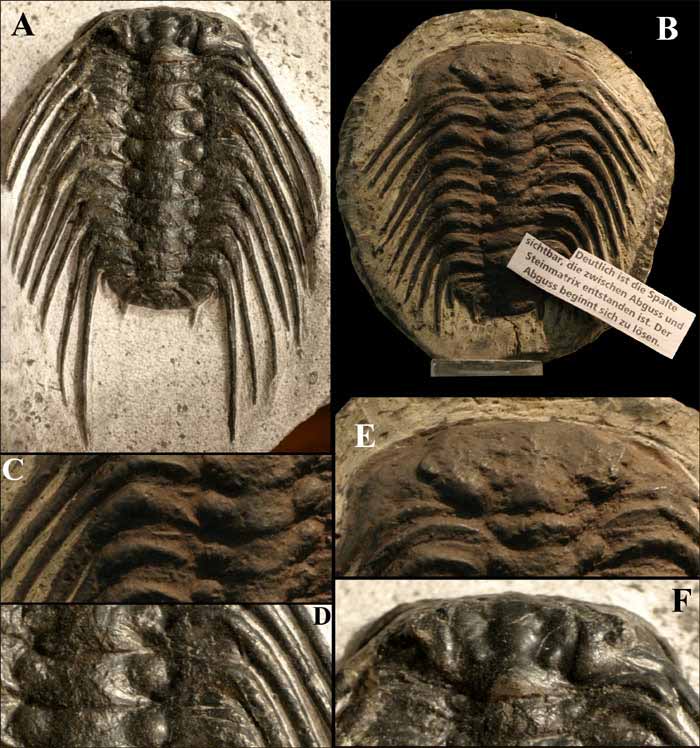
Picture 8: All Paradoxidae that can
be seen here are fake! A: Acadoparadoxides briareus Geyer
1993: brown-yellowish painted cast trilobite, about 25 cms
in length, fixed into
an artificial mould using resins, the arrows marking a crack
where the cast and the rock did not completely glue together,
the
circle
marking an area where the artisan working on the cast failed
the natural symmetry of the pleurae, it is quite certain that
fakes of this nature have been sold in the past. B: Cambropallas
telesto GEYER 1993: The same disintegration between cast
and matrix can be seen in this image (red circle), the pleural
tips have been created way too long and tipped (should look
like the pleurae to the left), the whole trilobite about 15
cms in length. C: very primitive fake of Cambropallas,
perhaps the rear section of the axis is real but everything
else is
made of resin or plaster, the glabellar furrows carved into
the cast, proportions inadequate compared to the real thing.
D: the cast has completely disintegrated from the mould it
was placed in. Photos taken by Sonntag, Photographs A, B, D:
collection Burkhard.
How can you tell fakes? For the most part the
trilobites are made of resin or plaster using negatives of
real Paradoxidae, painted and then fixed into a mould
dug into a real piece of
Cambrian
matrix. Because of the inadequate glueing between the
materials used the cast very often partially disintegrates
from the rock and tiny cracks appear along the cast/matrix-line
(see
Picture
8, A-B) or the cast disintegrates from the rock alltogether
and the whole construction falls apart (see Picture 8-D).
As far as the cast itself is concerned the same criteria als
already mentioned in the chapters on Devonian trilobites
apply. The casts often look very smooth and symmetric, preparation
marks and at least smaller damages that should be present in
real fossils are missing. There are neither cracks or missing
areas to the exoskeleton, remains of matrix between the
pleurae or the characteristic features of the exoskeleton surface
(e. g. the small tubercles on the exoskeleton of Cambropallas or
terrace lines on the free cheeks of Acadoparadoxides trilobites).
The natural color of the Cambrian Paradoxidae very
often is being imitated by using a brown-yellowish paste that
does not exactly match the real thing. Many fake trilobites
show a suspicious shade of yellow. The original exoskeleton
of Cambrian trilobites has usually been replaced over time
with hydrated iron oxides (often lemonite) of red and brown
color
or yellow
and brown, therefore black Cambrian trilobites have surely
been the subject of manipulation, painted over to cover restorations,
etc, and to create a "better contrast".
Evolution in Moroccan fakes - from
simple casts to imitations of matrix
The early times of trilobite fakes saw Moroccans
carving trilobites out of pieces of rock, which sometimes
led to very odd results due to the lack of morphological knowledge
to produce convincing fakes (see Picture 9-A). In the beginning
(and perhaps still today to fool tourists) not only trilobites
were reproduced but scorpions and even snakes including zig-zag
lines were carved out of and/or nto the rock. I have seen huge
wheels of ammonites completely fake. In most cases, though,
only the
inner circles of the ammonites, which are usually missing in
real findings, are restored. Well, maybe the artisan had a
good day and turned the piece of rock he was sitting on into
a nice huge ammonite - surely he will find a buyer for it.
As already stated the early fakes of trilobites were very primitive,
made of a little plaster or resin and the details formed using
a tool of sorts and before the material hardened. At times
this resulted in
fantasy trilobites with large numbers of thorax segments
or cephalons and pygidia that would not fit and/or were morphologically
incorrect. Perhaps the "trilobites" were created
out of memory or from bad sketches. The problem, apart form
the sometimes
ridiculous morphology, was that the border between cast material
and real matrix could be easily
told. Because of that, the artisans very soon adopted the procedure
to cover the whole chunk of rock with a layer of resin or plaster
mixed with crumbled rock and perhaps a little color into which
the cast trilobite is placed (see Picture 9 B-D). The trilobite
is made
by casting
resin
into
a negative.
The
hardened imitation is then placed into the artifical layer
and once the whole construction is hardened the border line
between fake trilobite and fake matrix as well as the line
between fake matrix and real rock is covered by extensive preparation
marks to deceive the unwary eye and cover tiny holes resulting
from bursting bubbles of gas in the hardening material. However
these preparation marks are very often way too irregular. After
that the whole creation is painted, often failing the
right color shades. The whole process of faking the trilobite
takes two hours perhaps (excluding the hardening process that
can take several hours to complete). A real trilobite, depending
on the kind of trilobite and the skill of the artisan prepping
it, will take at least 5 hours or more to complete, perfectly
prepared specimens may have seen 100 hours or more.
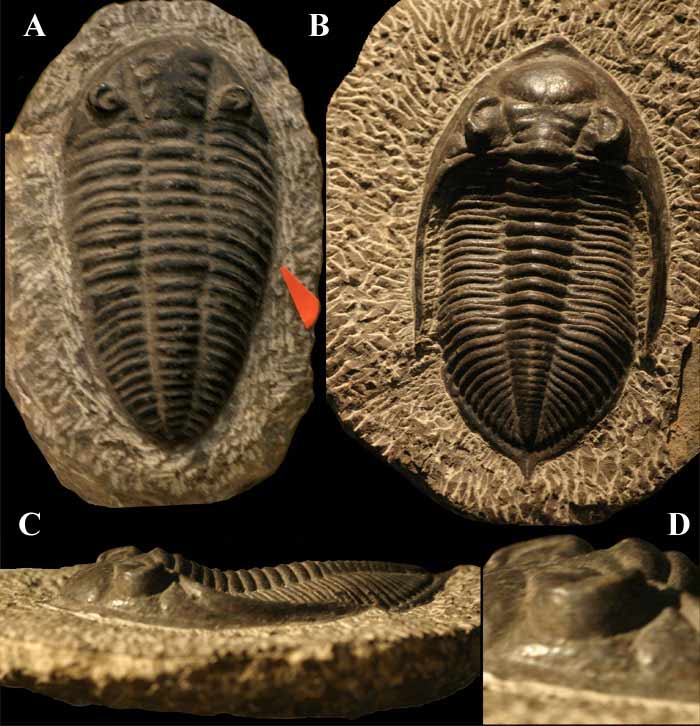
Picture 9: A: fantasy trilobite pretending to be a Phacopida from
the early times of trilobite fakes (piece was acquired in 1983).
B-D: good reproduction of Odontochile from the Lower
Devonian of Morocco, produced 20 years later. Apart from the
missing eye detail (lenses) the "trilobite" is morphologically
correct and detailed but being cast and fixed onto
a layer of resin or plaster on top of real rock. Photo B, bottom
right, clearly shows an area of disintegration of the artificial
layer from the matrix. Photos C and D show the smooth surface
of the eyes, eye detail is missing, there are no lenses as
with authentic specimens.
Psychopyge - beloved and frequently
faked
This impressive trilobite from the Lower Devonian
deposits of Morocco with its strange extension of the cephalon
is very popular with
collectors
and
therefore frequently subject to manipulation and fake. Authentic
specimens bear three rows of very fine spines (one row on the
axis and one row on each side at the borderline between pleurae
and pleural spines). Preparing these spines is very time-consuming
and difficult work and a specimen perfectly prepared will cost
a small fortune (4-digit sum in €, perhaps). But you will get
fakes for 30 €! So if you are looking for cheap material be
very careful when coming across Psychopyge trilobites!
A few years ago an acquaintance of ours very proudly presented
one
of these specimens to us and was very disappointed when - after
carefully investigating the trilobite under magnification -
we had to tell him that it was fake. Because of its bizarre
morphology Psychopyge is also very popular with the
general public on fairs, which may be one reason why this trilobite
is frequemtly found on the fake trilobite assemblages mentioned.
And cast single pieces with mock matrix have been selling
for years.
When we have a look at the faked Psychopyge in picture
10 below, what we notice is not only the brownish color and
the many tiny bubble holes in the resin but the very crude
preparation marks. You can tell a good preparator by the way
he "cleans up" his workplace, namely the matrix surrounding
the finished trilobite. A good preparator will try and give
beauty not only to the trilobite but to the matrix as well
by evenly roughening it and giving it a nice light color or
by carefully blasting it after which it becomes a nice grey.
The procedure also increases contrast between the fossil and
the
matrix.
The intention
to
create
something really beautiful is not too common with the people
faking trilobites so keep your hands off stuff that does not
look good.
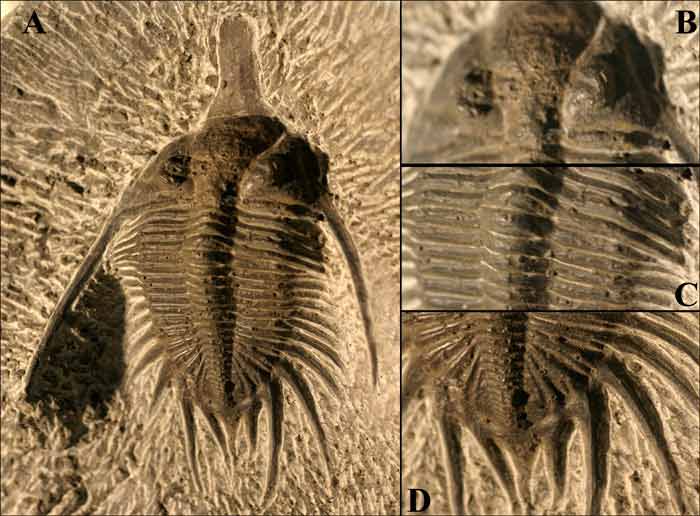
Picture 10: not too good a fake of Psychopyge
elegans from the Devonian deposits of
Morocco. Just another matrix imitation and a cast trilobite
on top, both the trilobite and
the underlying matrix werde made of resin. A: very suspicious
is the brownish-grey color of the trilobite (black would be
normal), the surface of the exoskeleton is rough and full of
bubble holes. B: magnified view of the cephalon - both
eyes and glabella seem to have been somewhat carelessly modelled.
C: the resin pleurae have
obviously
been carved a little, resulting in a sharp-looking appearance,
again: note the bubble holes! D. the tail spines seem to have
been
carved as well with some sharp modeling tool, bubble holes
again in both the "trilobite" exoskeleton and the
underlying
"matrix". Photography: Sonntag (We found this piece
with a Moroccon dealer on a German fossil show).
Dicranurus monstrosus - a frequently
faked horned trilobite
This trilobite has one of the most bizarre
morphologies coming from the Lower Devonian of Morocco. Remarkable
are the two very promiment horns on the occipital ring. The
trilobite is rare and rather difficult to prepare. At least
you cannot prepare this trilobite with simple tools as
have been used in Morocco early on. The difficult preparation
may be one reason why there are so many fales floating around,
another being that this trilobite usually represents the more
expensive kind of fossil. As already mentioned the crude preparation
marks indicate an old-style Moroccan preparation and should
already raise a red flag. In many cases the matrix (or resin
with faked trilobites) in between the horns has not been removed
(see Pic. 11) If the matrix shows a light brown color and the
exoskeleton a shade of brown (straight black would be normal)
then chances are you are dealing with a fake specimen.
Like
with the other trilobites we discussed the fakes of Dicranurus mostly
consist of both the trilobite and a matrix layer being cast
from resin or plaster and then glued
on top of a chunk of real matrix, the typical "imitated-matrix-fake".
Among all the faked trilobites of this species I have never
seen one with the matrix removed and the horns standing free.
That does not mean there are no real trilobites with matrix
in between the horns, it simply means that well-prepared trilobites
of this species frequently show free-standing horns.
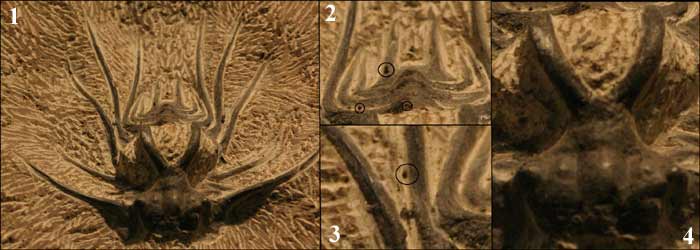
Pic. 11: A typical Dicranurus monstrosus fake
, about 10 cms in length. A cast trilobite and a cast layer of matrix glued onto
a chunk of real matrix. 1: frontal view of Dicranurus, clearly
visible are the crude prep marks pretending to be the real
thing. 2: the pygidium under magnification. Note the circled
tiny holes resulting from bursting bubbles of gas during the
hardening
process. 3: The pleurae have obviously been manipulated using
a sharp carving tool, the pleurae looking very sharp, real
ones are circular in shape. 4: cephalon under magnification:
note
the partially removed color from the left horn to prove the
fake and reveal the light color of the resin used.
Acanthopyge -
Advanced Faking !